The Second and Final Term of President Joko Widodo
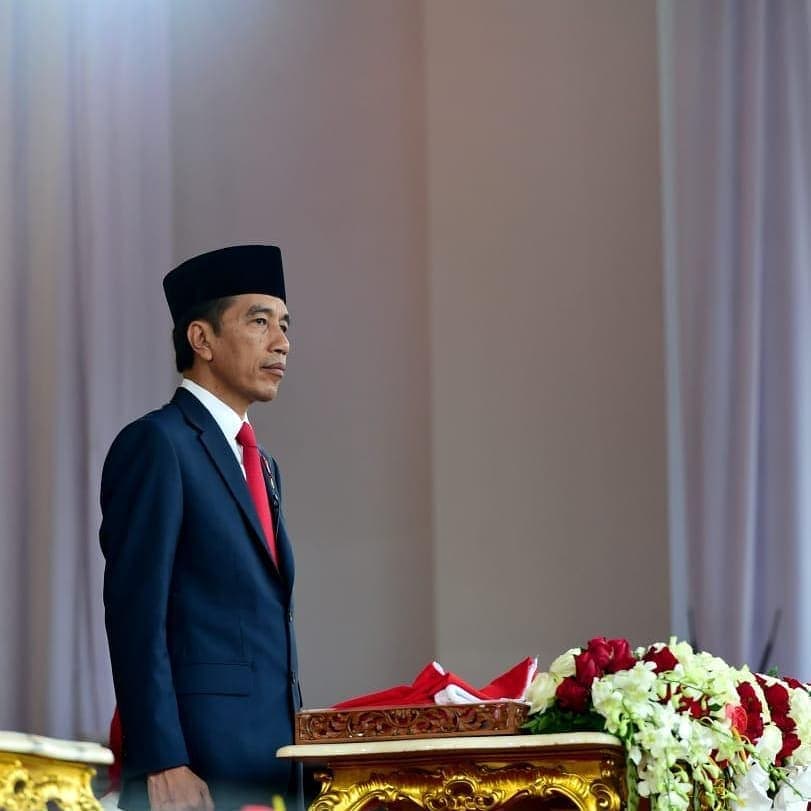
President elect Joko Widodo aims to bring the country back together with optimism to achieve his long-term plans for Indonesia.
Joko Widodo ‘Jokowi’ and Ma’ruf Amin were inaugurated as President and Vice President at the People’s Consultative Assembly (MPR) plenary session on Sunday, 20 October. Running for his second term as Indonesian president with a new VP, Jokowi brings hope for Indonesia, promising visionary goals on accelerating human development, whilst facing challenges to maintain accountability after facing a backlash especially in the wake of massive student protests.
After renewing his oath, President Jokowi delivered his speech in front of the House, government officials and foreign leaders attending the ceremony, stating confidence towards economic development and continuing a bureaucratic reform as the focus of his second term. Amid global uncertainty and various homegrown issues that desperately needed solving, Jokowi stated that investment in human development will be a major priority of his second-term administration in order to help the nation reach its full potential.
The President promised to improve economy by raising annual income to IDR 320 million per capita or a monthly income of IDR 27 million per capita. The goal includes poverty eradication initiative by avoiding economic disparity as Indonesia is set to become one of the top five world economies. “Our ambition is that by 2045, after one century of Indonesian independence, Indonesia should, Insya Allah (God willing), have escaped the middle-income trap.”
The President promised to improve economy by raising annual income to IDR 320 million per capita or a monthly income of IDR 27 million per capita.
Jokowi continues his presidency to reform the bureaucracy since he was elected as the Chief Executive in 2014. To achieve that goal, bureaucratic reform is considered key to catalyse economic growth. “In a world that is full of risk, very dynamic and very competitive, we have continued to develop new methods and new values. We should not get stuck in a monotone routine,” the President continued.
On his second and final term in the office, Jokowi will be carrying out five initiatives highlight (1) development of a dynamic workforce by extending endowment funds, (2) infrastructure development that connects access to the local economy and boosts people’s opportunity. (3) Simplification of obstructive regulation for two omnibus laws about job creation and SME empowerment (4), reformation in government body and convoluted bureaucracy, (5) and economic transformation that shifts the dependency of natural resources to modern manufacturing and service-based economy to achieve social justice for all the Indonesian people.
On Wednesday, 23 October, Jokowi announced the new cabinet with a list of ministers as part of his administration from 2019 - 2024. The executive office is filled with proportional names from professionals and political scene with a diverse group of people and a fresh names to be inducted into the new ministerial nomenclature. Below are the full list of the cabinet members.
Coming from the same political affiliation, Puan Maharani, elected first female house speaker for House of Representatives (DPR) indicates separation from typical political constraints as PDIP owns the majority seat at the House as well as other political factions that will join his administration. The recent formation between the executive and legislative hopes for better political will to implement his long policies and long-term goal including his vanity project to move the city from Jakarta to Palangkaraya. Prior to the inauguration, Jokowi had met with his ex-rival in the 2019 Presidential Election, Prabowo Subianto to make his second term at the office works effectively with opposition and his coalition.
With less spectacle in the inauguration compared to the 2014 event that followed with jubilation, the President chose to get ‘straight down to business’, calling for more urgent subject to use his political power that would affect people directly. In the midst of critics with some people began questioning his integrity and leadership qualities, Jokowi hopes to bring people together and underline his mission to unite the country.
In the next five years, Jokowi may have to prove his leadership to restore democracy to be more progressive and respect the constitution as well as reflect the Indonesian value “Unity in Diversity” (Bhinneka Tunggal Ika). Amid student protests over the revision of the Criminal Code, hazardous Forest Fire, controversy over anti-graft agency, and human rights violation in Papua at the beginning of the second tenure, Jowoki has his work cut out to win people’s heart with optimism as it is the last chance to make all the promise he made to Indonesian people.
President Jokowi ended his speech with a Bugis vernacular, “Pura babbara’ sompekku, pura tangkisi’ golikku (My sail is flying, my helm is mounted). Together we move toward an advanced Indonesia!”
Congratulations, President Jokowi and Vice President Ma’aruf Amin! We are looking forward to your endeavour for the future of Indonesia.
____
This article is adapted from various sources including the President’s inauguration speech at The House of Representatives.