
Foundations of the ASEAN
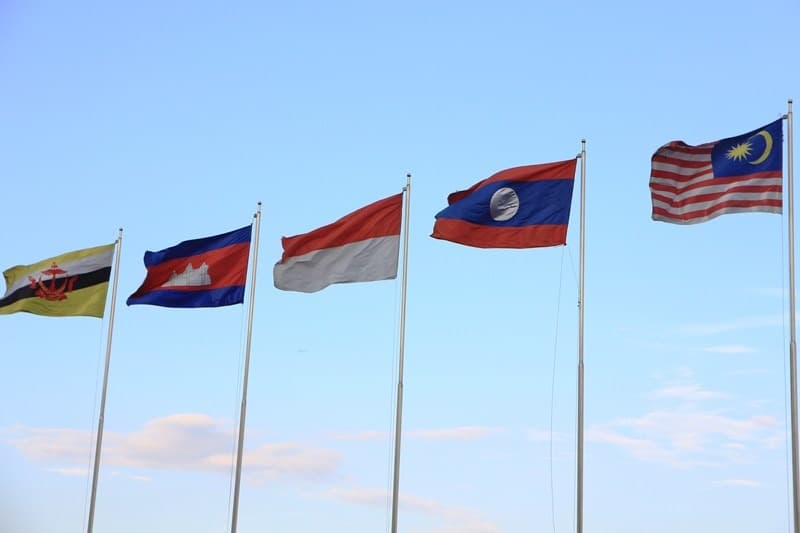
The Association of Southeast Asian Nations (ASEAN), was established on 8 August 1967 in Bangkok, Thailand, with the signing of the ASEAN Declaration (Bangkok Declaration) by the Founding Members of ASEAN: Indonesia, Malaysia, Philippines, Singapore and Thailand.
Over the years it expanded to include Brunei Darussalam which joined on 7 January 1984, Viet Nam on 28 July 1995, Lao PDR and Myanmar on 23 July 1997, and Cambodia on 30 April 1999, making up what is today the ten Member States of ASEAN.
Aims and Purposes
As set out in the ASEAN Declaration, the aims and purposes of ASEAN are:
Fundamental Principles
In their relations with each another, the ASEAN Member States have adopted the following fundamental principles, as contained in the Treaty of Amity and Cooperation in Southeast Asia (TAC) of 1976:
ASEAN Community
The ASEAN Vision 2020, adopted by the ASEAN Leaders on the 30th Anniversary of ASEAN, agreed on a shared vision of ASEAN as a concert of Southeast Asian nations, outward looking, living in peace, stability and prosperity, bonded together in partnership in dynamic development and in a community of caring societies.
At the 9th ASEAN Summit in 2003, the ASEAN Leaders resolved that an ASEAN Community will be established.
At the 9th ASEAN Summit in 2003, the ASEAN Leaders resolved that an ASEAN Community will be established.
At the 12th ASEAN Summit in January 2007, the Leaders affirmed their strong commitment to accelerate the establishment of an ASEAN Community by 2015 and signed the Cebu Declaration on the Acceleration of the Establishment of an ASEAN Community by 2015.The establishment of the ASEAN Economic Community (AEC) in 2015 is a major milestone in the regional economic integration agenda in ASEAN, offering opportunities in the form of a huge market of USD2.6 trillion and over 622 million people. In 2014, AEC was collectively the third largest economy in Asia and the seventh largest in the world.
The AEC Blueprint 2025 is aimed towards achieving the vision of having an AEC by 2025 that is highly integrated and cohesive; competitive, innovative and dynamic; with enhanced connectivity and sectoral cooperation; and a more resilient, inclusive, and people-oriented, people-centred community, integrated with the global economy.
The AEC Blueprint 2025 consists of five interrelated and mutually reinforcing characteristics, namely: (i) A Highly Integrated and Cohesive Economy; (ii) A Competitive, Innovative, and Dynamic ASEAN; (iii) Enhanced Connectivity and Sectoral Cooperation; (iv) A Resilient, Inclusive, People-Oriented, and People-Centred ASEAN; and (v) A Global ASEAN.
Adapted from www.asean.org